
Seasoning Cast-Iron That Actually Stays Non-Stick: The Quick Heat Method Explained
Cast iron has a reputation for being indestructible—and somehow still sticky. If you’ve ever followed seasoning instructions to the letter and ended up with a pan that feels tacky or uneven, the problem isn’t cast iron. It’s the way seasoning is usually explained.
Seasoning isn’t about coating a pan in oil and hoping for the best. It’s about using heat to permanently bond oil to iron. Get the oil wrong, apply it too thick, or stop short on temperature, and you don’t get a non-stick surface—you get residue.
This guide focuses on a quick heat method that actually works: choosing the right oil, applying impossibly thin layers, hitting real polymerization temperatures, and maintaining seasoning with a simple wipe-warm routine after cooking. We’ll also fix sticky pans, rescue light rust, and show how everyday cooking reinforces the surface instead of breaking it down. No folklore. Just repeatable results.
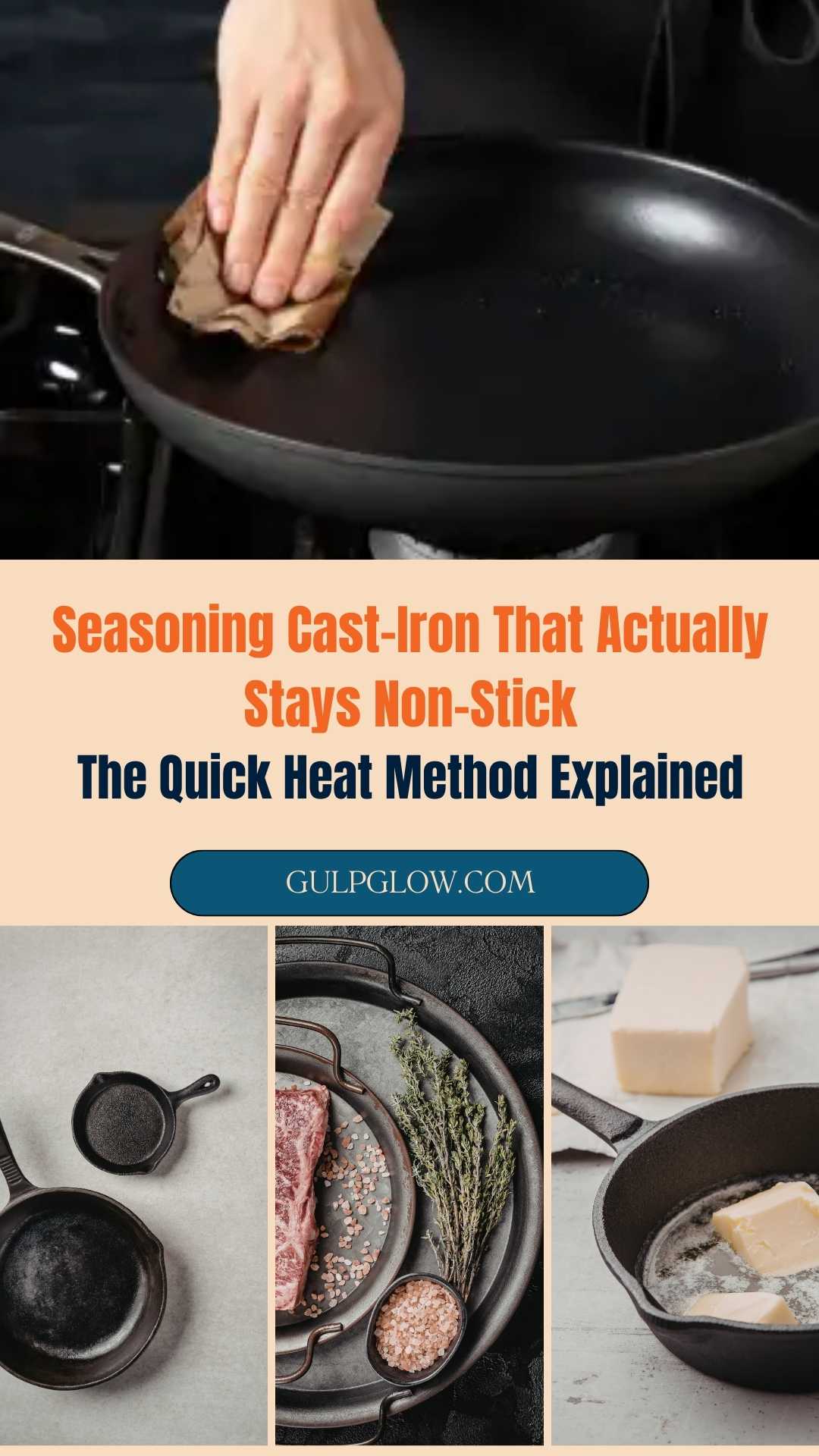
Why Cast Iron Gets Sticky (and Why Most Seasoning Advice Fails)
When a cast-iron pan feels sticky, it isn’t because it “needs more oil.” It’s usually because it got too much oil and not enough heat.
Seasoning works when oil is heated past its smoke point long enough to polymerize—that is, transform into a hard, dry, bonded layer. If the oil layer is too thick, the top surface polymerizes while the oil underneath stays soft. The result is a tacky film that grabs at food instead of releasing it.
Another common mistake is underheating. A pan warmed to 300–350°F may darken oil, but it won’t fully polymerize it. That’s how you end up with a surface that looks seasoned but feels gummy.
And then there’s the “just cook bacon” advice. Cooking fatty food can help maintain seasoning, but it doesn’t correct a poorly bonded base layer. If the foundation is sticky, adding more fat won’t fix it.
The goal isn’t to make the pan shiny. The goal is to create a thin, dry, hard layer that feels smooth—not greasy.
What Seasoning Actually Is: Polymerization, Not Coating
Seasoning isn’t oil sitting on metal. It’s oil that has been chemically transformed by heat.
When oil reaches high enough temperatures—typically 400–500°F (205–260°C)—its molecules break apart and recombine into long-chain polymers. Those polymers bond to the iron surface and to each other, forming a hard, plastic-like matrix. That’s your non-stick layer.
This is why:
- Thin coats matter
- High heat matters
- Time at temperature matters
Smoke is part of the process—but it isn’t the finish line. Seeing smoke means the oil has reached its smoke point. Polymerization happens after that point is sustained, not the moment smoke appears.
Think of seasoning like curing paint. If you apply it too thick, it never fully hardens. If you don’t heat it enough, it never sets.
Oil Choice: What Works, What Fails, and Why
Not all oils behave the same under high heat. The best seasoning oils are neutral, refined, and high in polyunsaturated fats, which polymerize efficiently.
Oils that work well
- Grapeseed oil
- Canola oil
- Soybean oil
- Refined sunflower oil
These oils have high smoke points and stable behavior at seasoning temperatures. They form durable layers when applied thinly.
Oils that cause problems
- Olive oil: Lower smoke point and more impurities. Often leaves sticky patches.
- Flaxseed oil: Polymerizes quickly but becomes brittle and prone to flaking.
- Butter: Milk solids burn before proper bonding occurs.
- Unrefined oils: Contain particles that interfere with smooth layers.
If your pan feels tacky after seasoning, oil choice is often part of the issue—but thickness and temperature are usually the bigger culprits.
The Quick Heat Seasoning Method (Step-by-Step)
This method prioritizes thin layers and real heat, without overcomplicating the process.
Step 1: Clean and fully dry
Wash the pan with soap and water. Yes, soap is fine. Rinse thoroughly.
Place it on the stovetop over medium heat for a few minutes until completely dry. Moisture trapped in pores will interfere with bonding.
Step 2: Apply oil (then remove almost all of it)
Add a small amount of oil—about a teaspoon.
Rub it over the entire surface, inside and out. Then take a clean towel and wipe it off as if you made a mistake. The pan should look nearly dry. No pooling. No shine.
If it looks glossy, there’s too much oil.
Step 3: Stovetop heat
Place the pan over medium-high heat until it begins to smoke lightly. This jump-starts polymerization and ensures the oil is actually reaching the right range.
Step 4: Oven finish
Transfer the pan upside down into a 450°F (230°C) oven for about 45–60 minutes.
Turn the oven off and let the pan cool inside.
How many rounds?
Two to three thin layers are enough for a strong base. More layers don’t necessarily improve performance if they aren’t properly bonded.
What matters isn’t quantity—it’s quality of each coat.
Daily Maintenance: The Wipe-Warm Routine That Keeps It Non-Stick
Seasoning isn’t something you “finish.” It’s something you maintain lightly and consistently. The good news is that maintenance takes less than a minute if you do it while the pan is still warm.
After cooking:
- Rinse the pan under warm water. Use a brush or sponge to remove residue. Soap is fine if needed—just don’t soak the pan.
- Dry it on the stovetop over medium heat until all visible moisture evaporates.
- Add a few drops of oil (this is your maintenance oil).
- Wipe it over the surface, then wipe again until the pan looks almost dry.
- Let it heat just until you see the faintest hint of smoke, then turn off the burner.
That final warm step bonds the micro-layer you just applied. It prevents rust and gradually strengthens the seasoning with use.
If you skip this routine, seasoning doesn’t “disappear”—it just degrades faster. Consistency is what makes cast iron feel effortless over time.
Rust Rescue & Sticky Pan Fix (No Panic Required)
Cast iron looks dramatic when something goes wrong, but most problems are easy to fix.
Light rust
If you see orange spots:
- Sprinkle coarse salt into the pan.
- Add a small amount of oil.
- Scrub firmly with a towel or brush.
- Rinse, dry on heat, and apply one thin seasoning coat.
Rust means moisture sat too long. It doesn’t mean the pan is ruined.
Sticky or gummy surface
This is usually from:
- Too much oil
- Not enough heat
- Thick layering
To fix it:
- Place the pan in a 450–500°F oven for 45–60 minutes to finish polymerizing excess oil.
- If stickiness remains, scrub lightly and reapply a very thin coat properly.
You rarely need to strip the entire pan unless layers are flaking or rust is deep. Most issues are surface-level and reversible.
Cooking That Builds Seasoning (Instead of Destroying It)
The best way to improve seasoning isn’t endless oven cycles—it’s cooking.
High-heat searing with a little fat reinforces the surface. When you brown meat at proper temperature, you’re essentially repeating controlled micro-seasoning.
Dishes that start with a strong sear—like many soups and stews—naturally strengthen the pan before liquid is added. The key is letting the surface heat fully before introducing food.
Acidic ingredients deserve context. Tomatoes and wine won’t instantly ruin a seasoned pan, but long acidic simmers in a newly seasoned skillet can weaken thin layers. Once seasoning is established, moderate acid use is fine.
Brown butter is another common question. It’s perfectly safe in a well-seasoned pan. The milk solids brown, but they don’t interfere with a properly bonded seasoning layer—especially if you follow the wipe-warm routine afterward.
Cooking should make your pan better, not fragile.
Common Myths (Quick Reality Check)
Some cast-iron advice sticks around longer than it should.
- “Soap ruins cast iron.” Modern soap doesn’t strip polymerized seasoning.
- “More oil makes it more non-stick.” Thick oil causes stickiness.
- “Flaxseed oil is best.” It often flakes over time.
- “You only season once.” Seasoning improves gradually through use.
Cast iron isn’t delicate. It just rewards thin layers and real heat.
Summary: What Actually Makes Cast Iron Non-Stick
A non-stick cast-iron pan isn’t about magic or tradition. It’s about three simple things:
- Apply oil thinly—thinner than feels necessary.
- Heat it hot enough for true polymerization.
- Maintain it lightly but consistently.
Do that, and the surface becomes smooth, durable, and reliable. Skip those principles, and you get sticky patches and frustration.
Cast iron doesn’t need perfection. It needs thin coats, high heat, and regular use. Everything else is just noise.
