Stirring to Clarity: How to Stir Cocktails for Perfect Chill, Dilution, and Texture
Stirring looks simple—almost passive—but it’s one of the most deliberate actions behind the bar. When a drink is built entirely from spirits, every rotation matters. There’s no citrus to hide mistakes, no foam to soften edges. Chill and dilution are the drink.
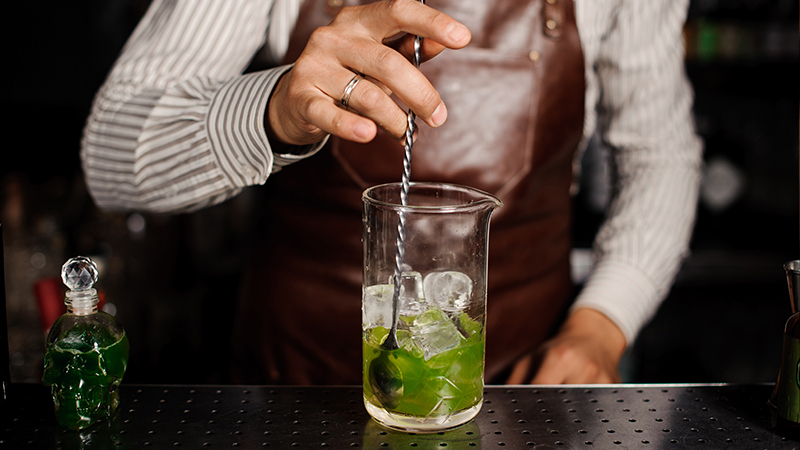
Stirring isn’t about mixing ingredients together; that part is over in seconds. What you’re really doing is controlling temperature and water, slowly and precisely, until the drink reaches its best version of itself. Too little, and it tastes hot and disjointed. Too much, and it goes flat.
This guide breaks down how stirring actually works: how ice choice affects dilution, why spinning the ice matters more than counting stirs, and how to read visual and tactile cues instead of relying on rigid numbers. Whether you’re stirring a Martini, Manhattan, or Old Fashioned, the goal is the same—clarity, balance, and a texture that feels intentional rather than accidental.
Why Stirring Exists (and Why Shaking Is the Wrong Tool Here)
Stirring exists because some drinks don’t need air—they need restraint. Spirit-forward cocktails are already homogeneous. Whiskey, vermouth, and bitters mix instantly. What they don’t have is the right temperature or the right amount of water. Stirring is how you add both, slowly and predictably.
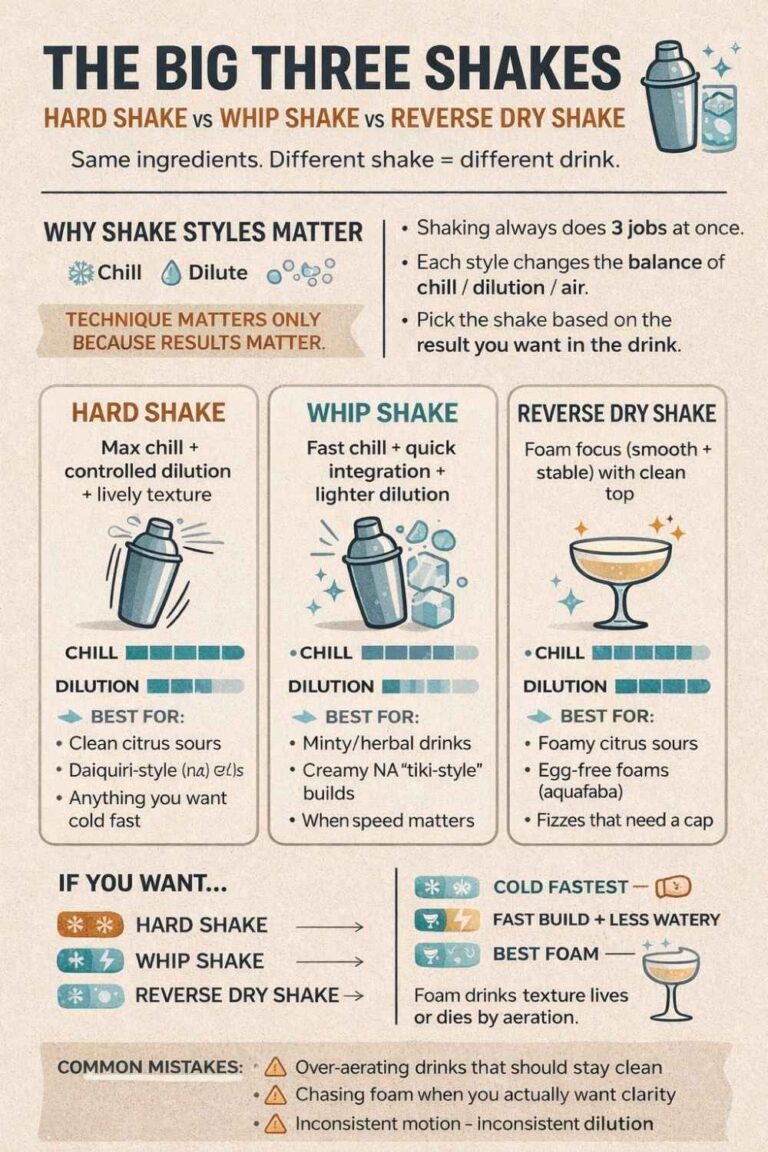
Shaking solves a different problem. It’s designed to chill fast, introduce air, and aggressively dilute—perfect for citrus, dairy, or egg drinks that need integration and lift. Apply that same force to a Martini or Manhattan and you get cloudiness, sharp dilution spikes, and a texture that feels broken instead of seamless.
Stirring keeps the liquid dense and glossy. No bubbles. No foam. Just a controlled glide toward balance. If a drink’s appeal depends on clarity, aromatics, and mouthfeel, stirring isn’t tradition—it’s the correct tool.
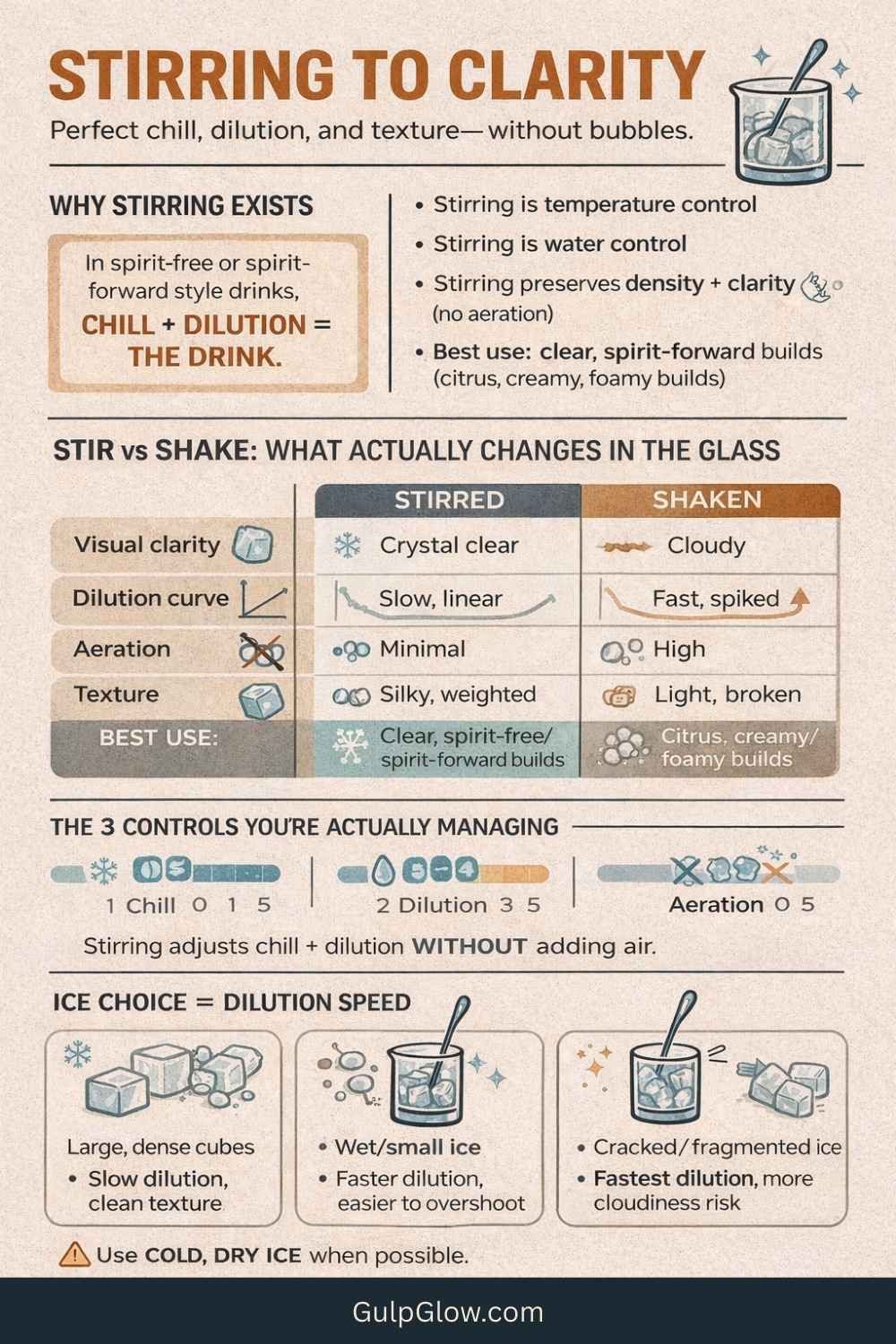
Stir vs Shake: What Actually Changes in the Glass
Rather than thinking in rules (“never shake a Martini”), it helps to think in outcomes. Shaking and stirring push the drink toward very different physical states.
When you shake, ice fractures and air is trapped in suspension. Dilution happens quickly and unevenly. The drink looks opaque and tastes brighter but less precise.
When you stir, ice stays intact. Water enters the drink gradually as the outer layer melts. The liquid remains clear, viscous, and aromatically focused.
Here’s the practical difference:
| Factor | Stirred | Shaken |
|---|---|---|
| Visual clarity | Crystal clear | Cloudy |
| Dilution curve | Slow, linear | Fast, spiked |
| Aeration | Minimal | High |
| Texture | Silky, weighted | Light, broken |
| Best use | Spirit-forward | Citrus / dairy / egg |
If a drink is meant to showcase the spirit itself, stirring preserves what makes it special instead of rearranging it.
Ice Is the Engine: Type, Size, and Condition
Before talking about motion or technique, it’s worth stating plainly: ice does most of the work. Stirring doesn’t create dilution—melting ice does. Your job is to manage that melt.
Ice type and size
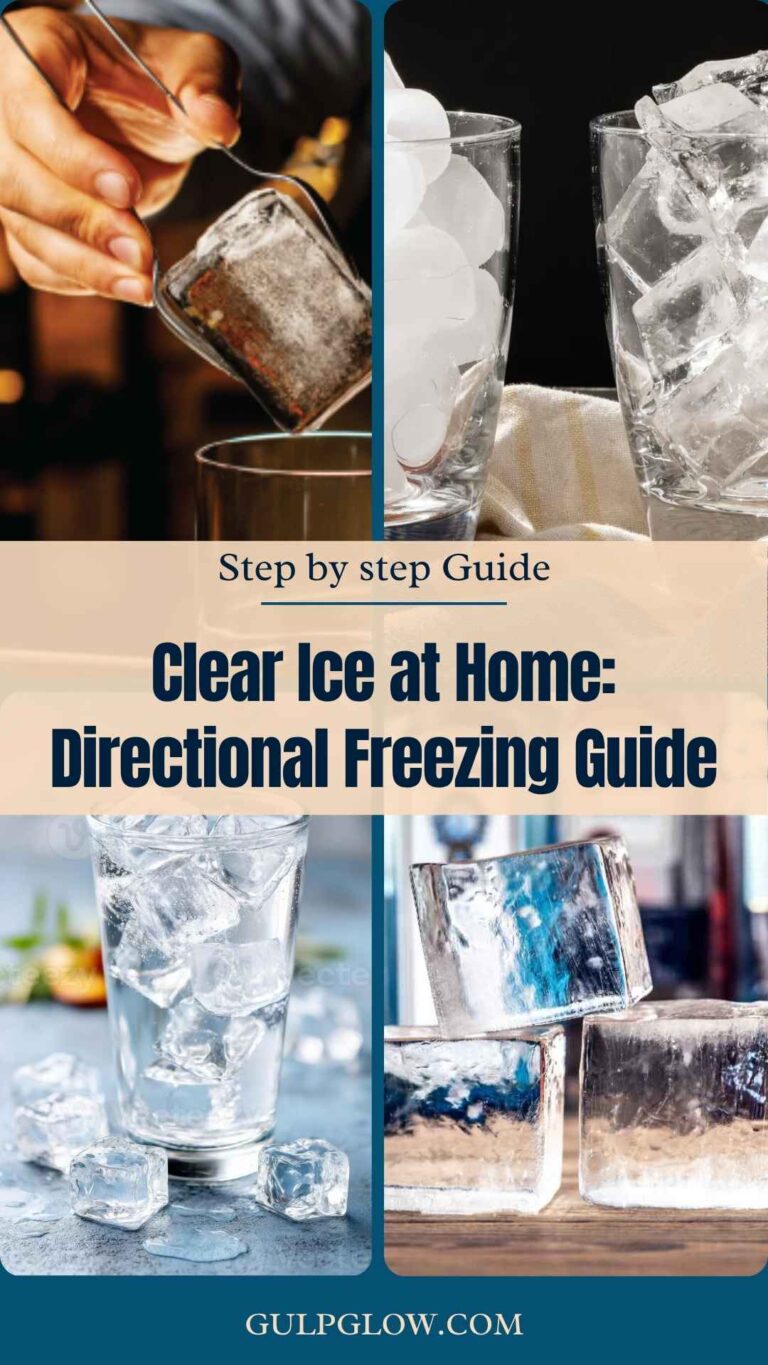
Large, dense cubes give you the most control. They melt slowly, predictably, and allow longer stirring windows without overshooting dilution. This is where clear ice shines, which is why many bartenders pair serious stirring with directional-frozen cubes.
Standard freezer cubes work, but expect a narrower margin for error. Cracked or crushed ice melts too fast and makes precise stirring almost impossible.
Ice condition
Dry, freezer-cold ice behaves differently than wet ice sitting in a well. Wet ice introduces dilution before you even start stirring, forcing you to stop early or accept a thinner drink.
If your drink tastes watered down despite short stirring, the problem usually isn’t your technique—it’s your ice.
The Stir Itself: Spin, Motion, and Barspoon Ergonomics
Once the ice is right, stirring becomes about guiding movement, not forcing it.
The goal isn’t to churn. It’s to create a smooth, continuous rotation where the ice and liquid move together as a single mass. The barspoon is there to maintain that spin, not to paddle the drink.
Barspoon ergonomics
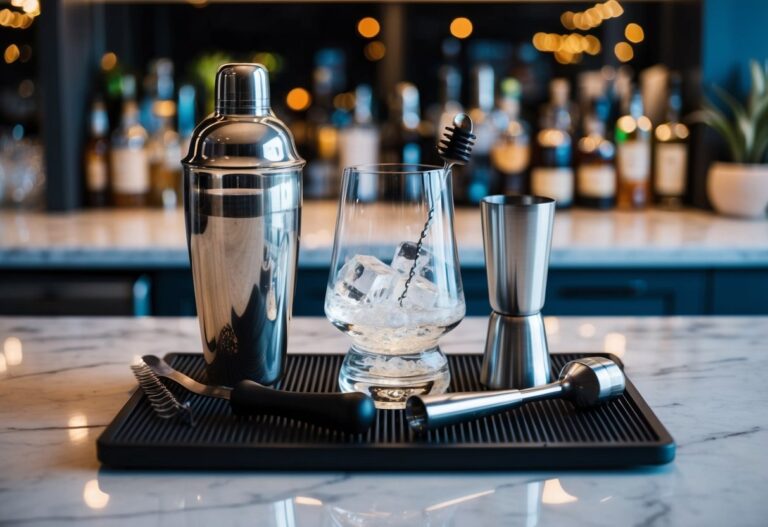
The twisted handle isn’t decorative. It helps the spoon slide along the inside of the glass with minimal friction. Hold the spoon lightly between thumb and first two fingers, letting it roll rather than grip tightly.
Your wrist should move more than your arm. If your elbow is working hard, you’re probably overdoing it.
What good stirring looks (and sounds) like
- The ice rotates smoothly, not chaotically
- There’s minimal clinking
- The surface stays calm—no splashing
- The liquid thickens slightly as it chills
If it sounds loud or looks turbulent, slow down. Precision beats enthusiasm here.
30–40 Rotations vs Temperature & Dilution Targets
You’ll often hear advice like “stir for 30–40 rotations.” It’s not wrong—but it’s incomplete. Counting stirs is a proxy, not a target. It works only when everything else is consistent: ice size, starting temperature, glass thickness, room temp. Change any of those, and the number stops meaning much.
A better way to think about stirring is to aim for results, then use rotations as a rough guide.
What you’re actually targeting
- Temperature: about –1°C to 1°C (30–34°F)
- Dilution: roughly 18–25% added water for most spirit-forward drinks (recipe-dependent)
Those numbers sound technical, but you don’t need a thermometer every time. With practice, you can read readiness from cues:
- The mixing glass develops a light frost
- The liquid looks slightly thicker and moves more slowly
- Ice edges soften but remain mostly sharp
- Aromas become rounder, less volatile
Rotations help beginners build consistency. Sensory cues are what keep experts accurate when conditions change.
Glass Chilling: The Step That Saves You from Over-Stirring
A perfectly stirred drink can be ruined by a warm glass. If the serving glass isn’t cold, the drink starts warming the moment you pour—forcing you to over-stir just to compensate.
Think of glass chilling as part of the same system as stirring, not a separate prep step.
Best options
- Freezer: most effective, most consistent
- Ice-water bath: works quickly if the freezer isn’t available
For drinks like a Martini, glass temperature matters enormously. The colder the glass, the less dilution you need to reach balance. For an Old Fashioned served over ice, it matters less—but even there, a chilled glass slows melt and preserves structure.
If your drinks keep tasting thin despite careful stirring, check the glass temperature before blaming your technique.
Putting It Together: Stirring the Classics
Stirring isn’t one-size-fits-all. Each spirit-forward drink has a slightly different tolerance for dilution and temperature.
Martini
The Martini is the most demanding test of stirring. There’s nowhere to hide.
- Lower dilution window
- Emphasis on clarity and aromatics
- Aggressive glass chilling required
Stop stirring a little earlier than feels comfortable. The colder glass will finish the job.
Manhattan
Manhattans are more forgiving.
- Vermouth and bitters tolerate a touch more water
- Texture matters as much as temperature
- Slightly longer stirring improves integration
Aim for silk rather than razor sharpness.
Old Fashioned
Here you have two valid approaches:
- Stir separately, then strain over a large cube for maximum control
- Build in glass and let the ice handle dilution gradually
In both cases, ice choice matters more than stirring time. Clear, dense cubes change everything.
Common Stirring Mistakes (and What They Tell You)
Mistakes repeat for a reason—they’re diagnostic.
If a drink tastes hot, it’s under-stirred or served in a warm glass.
If it tastes thin, you likely over-stirred or used wet ice.
If it looks cloudy, the ice was chipped or the motion too aggressive.
If aromas feel muted, dilution went too far.
Instead of adjusting the recipe, adjust the process.
Summary: Stirring as Controlled Dilution
Stirring isn’t passive and it isn’t decorative. It’s a controlled way to add water, remove heat, and preserve texture—nothing more, nothing less.
- Ice quality sets the ceiling
- Motion controls the pace
- Temperature and dilution define readiness
When stirring is done well, it disappears. What’s left is a drink that feels calm, clear, and intentional—the kind that makes a Martini, Manhattan, or Old Fashioned feel exactly the way it should.